Standing Liberty quarters, 1916–1930
Liberty stands in a gateway. Check the stars under the flying eagle and the height of the date on the pedestal.
Which 1917 type do I have?
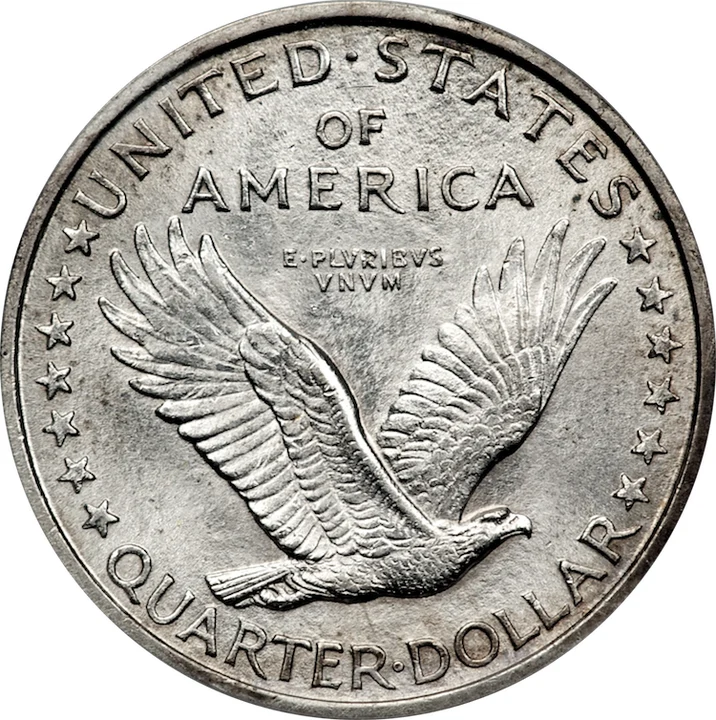
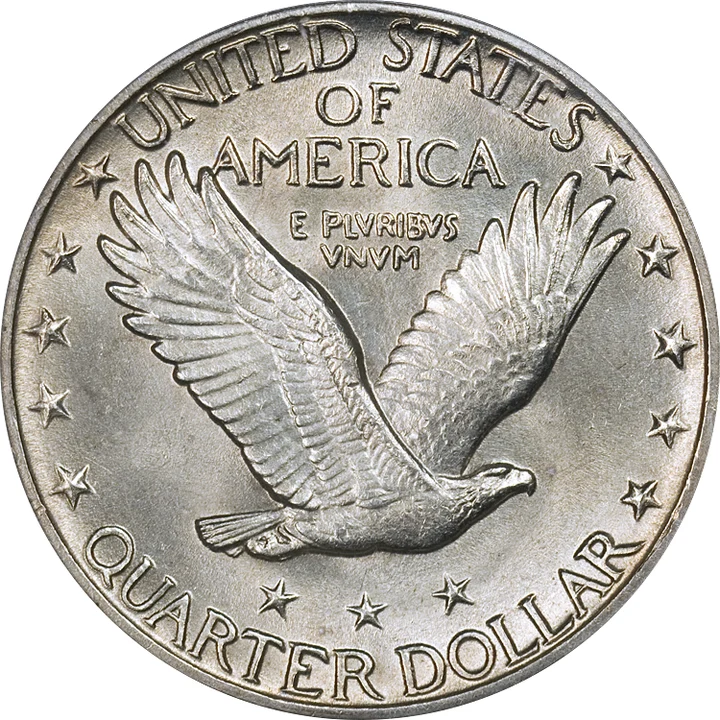
Turn the coin over and look directly below the eagle. The two reverse types both appear on 1917 quarters. The photographs show the feature to compare. Each caption identifies the specimen’s own date.
Type 1 · no stars below the eagle


Type 2 · three stars below the eagle


What if the date has worn away?
Three stars below the eagle identify the later reverse. On the front, look at the base below Liberty’s feet. A raised date was used through 1924. A recessed date began in 1925. These features can narrow the type when an exact year is unreadable. For D or S, check the front just above and to the left of the date.
PCGS type reference · PCGS date comparison · Compare the 1917 mintages
Standing Liberty, no stars beneath eagle
Check the space below the eagle. An empty field there identifies the original reverse even if the figure on the other side is worn.
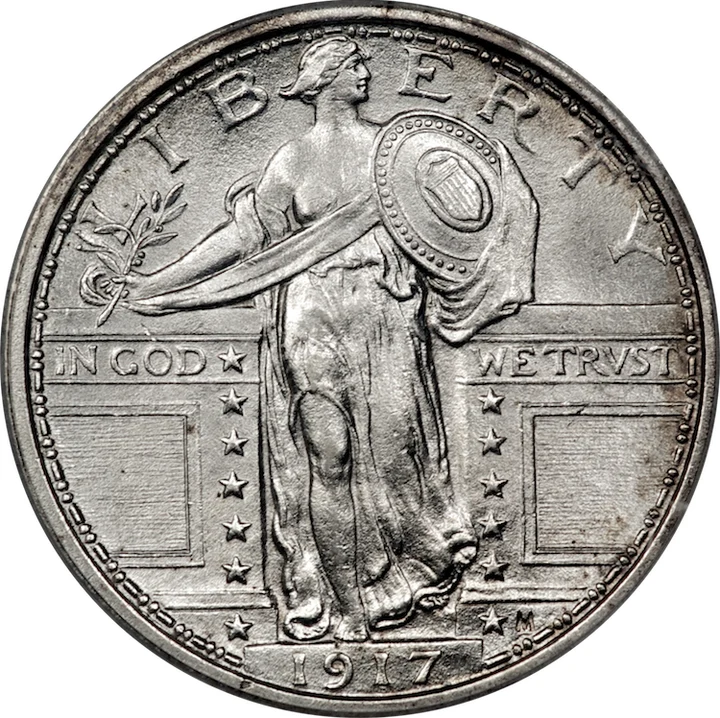


- Front
- Liberty stands in a gateway with a shield and an olive branch. Her upper torso has no chain-mail covering.
- Back
- An eagle flies right with stars placed to its sides. None sits below the bird.
A second design appeared during 1917. It has chain mail and three stars beneath the eagle.
Hermon A. MacNeil’s standing figure replaced the Barber portrait in 1916. The two types overlap in 1917, making the reverse especially useful.
PCGS CoinFacts type reference · PCGS explanation of the recessed date
Standing Liberty, stars and raised date
First find three stars below the bird. If the date sits on top of the pedestal, it belongs to the earlier of the two chain-mail subtypes.
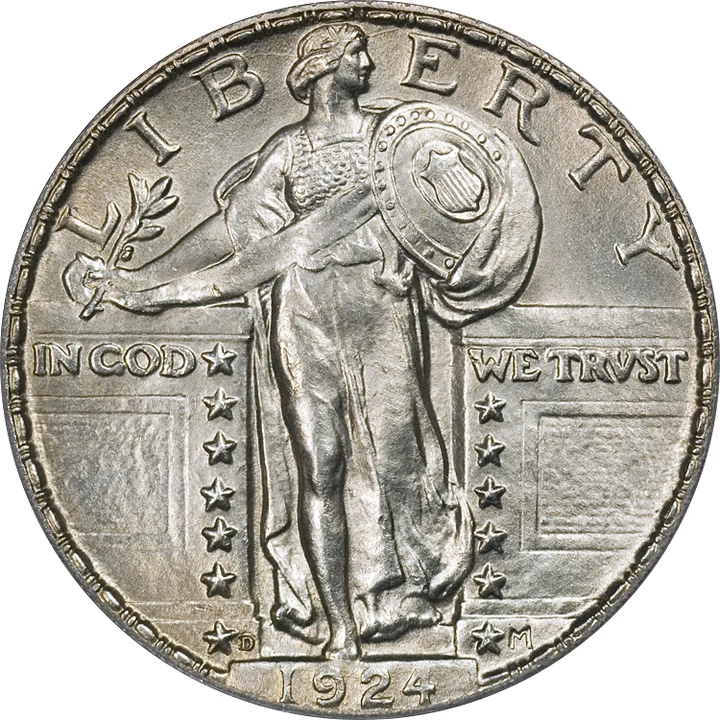


- Front
- Liberty wears chain mail and holds a shield and branch. The date sits high on the exposed face of the pedestal.
- Back
- Three stars lie beneath the flying eagle, with the remaining stars to its sides.
Dates on worn early pieces frequently disappear. An unreadable date on its own cannot identify a date or mint. The next design sinks the date into a recess.
The Mint revised the front and back during 1917. No Standing Liberty quarters were issued in 1922.
PCGS CoinFacts type reference · PCGS explanation of the recessed date
Standing Liberty, stars and recessed date
Look for the protective border around the date. The surrounding recess distinguishes this subtype from the raised-date version.
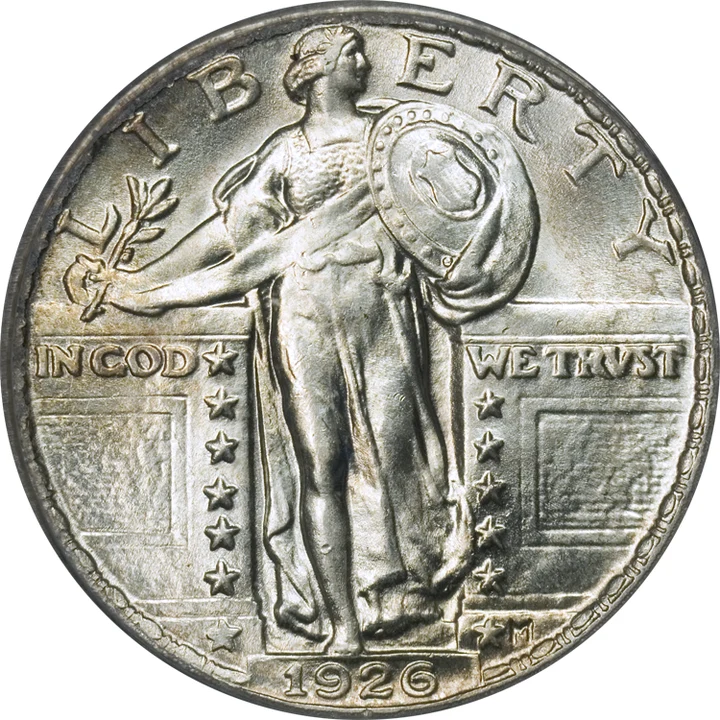


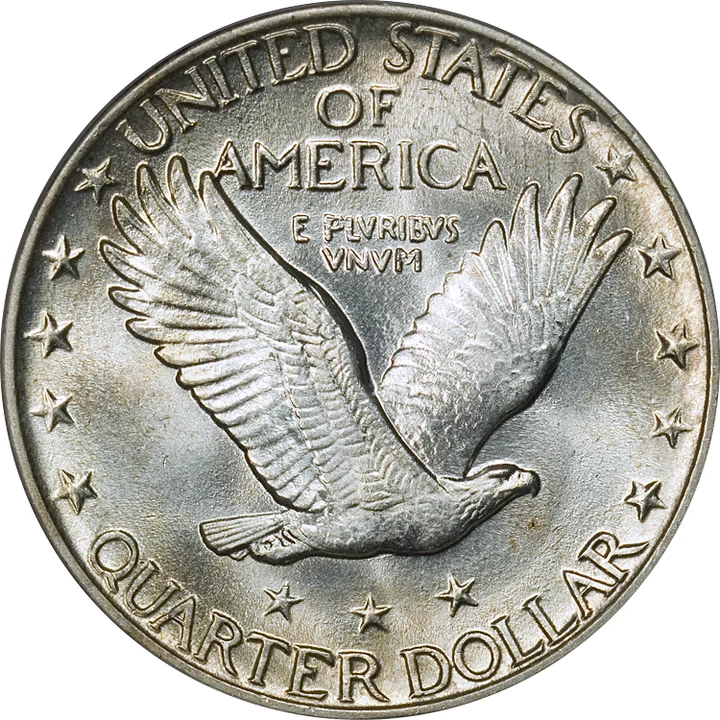


- Front
- The date is sunk into a shallow recess in the pedestal below Liberty. She still wears chain mail and carries a shield.
- Back
- The flying eagle retains the three stars directly below it.
Three stars below the eagle fit both later subtypes. Check the front before choosing the 1917–1924 or 1925–1930 entry.
The Mint recessed the date in 1925 to reduce wear. The final Standing Liberty quarters are dated 1930.
PCGS CoinFacts type reference · PCGS explanation of the recessed date
The early-series figures describe the circulation issues in the linked records. If a reported quantity covers more than one subtype, the combined date-and-mint slot appears once.
Dates and mint marks
34 separately collectible date and mint entries. Check the ones you have. The printed list follows your filter and leaves out your collected issues.
| Have | Date | Mark & mint | Mintage |
|---|---|---|---|
| 1916 | No mint markPhiladelphia | 52,000Philadelphia struck two quarter designs in 1916. The 1,788,000 Barber and 52,000 Standing Liberty quarters together match the Mint’s annual Philadelphia count of 1,840,000. Issue source | |
| 1917 | No mint markPhiladelphia | 22,620,000Both reverse designs were struck at this mint in 1917. The date-and-mint total combines the two separately catalogued production figures. Issue source | |
| 1917 | DDenver | 7,733,600Both reverse designs were struck at this mint in 1917. The date-and-mint total combines the two separately catalogued production figures. Issue source | |
| 1917 | SSan Francisco | 7,504,000Both reverse designs were struck at this mint in 1917. The date-and-mint total combines the two separately catalogued production figures. Issue sourceProduction details | |
| 1918 | No mint markPhiladelphia | 14,240,000 Issue source | |
| 1918 | DDenver | 7,380,000The Mint’s Denver calendar-year table records 7,380,000 quarters. PCGS and Stack’s Bowers independently list the same circulation mintage. Issue source | |
| 1918 | SSan Francisco | 11,072,000 Issue source | |
| 1919 | No mint markPhiladelphia | 11,324,000 Issue source | |
| 1919 | DDenver | 1,944,000 Issue source | |
| 1919 | SSan Francisco | 1,836,000 Issue source | |
| 1920 | No mint markPhiladelphia | 27,860,000 Issue source | |
| 1920 | DDenver | 3,586,400 Issue source | |
| 1920 | SSan Francisco | 6,380,000 Issue source | |
| 1921 | No mint markPhiladelphia | 1,916,000 Issue source | |
| 1923 | No mint markPhiladelphia | 9,716,000 Issue source | |
| 1923 | SSan Francisco | 1,360,000 Issue source | |
| 1924 | No mint markPhiladelphia | 10,920,000 Issue source | |
| 1924 | DDenver | 3,112,000 Issue source | |
| 1924 | SSan Francisco | 2,860,000 Issue source | |
| 1925 | No mint markPhiladelphia | 12,280,000 Issue source | |
| 1926 | No mint markPhiladelphia | 11,316,000 Issue source | |
| 1926 | DDenver | 1,716,000 Issue source | |
| 1926 | SSan Francisco | 2,700,000 Issue source | |
| 1927 | No mint markPhiladelphia | 11,912,000 Issue source | |
| 1927 | DDenver | 976,000 Issue source | |
| 1927 | SSan Francisco | 396,000 Issue source | |
| 1928 | No mint markPhiladelphia | 6,336,000 Issue source | |
| 1928 | DDenver | 1,627,600 Issue source | |
| 1928 | SSan Francisco | 2,644,000 Issue source | |
| 1929 | No mint markPhiladelphia | 11,140,000 Issue source | |
| 1929 | DDenver | 1,358,000 Issue source | |
| 1929 | SSan Francisco | 1,764,000 Issue source | |
| 1930 | No mint markPhiladelphia | 5,632,000 Issue source | |
| 1930 | SSan Francisco | 1,556,000 Issue source |